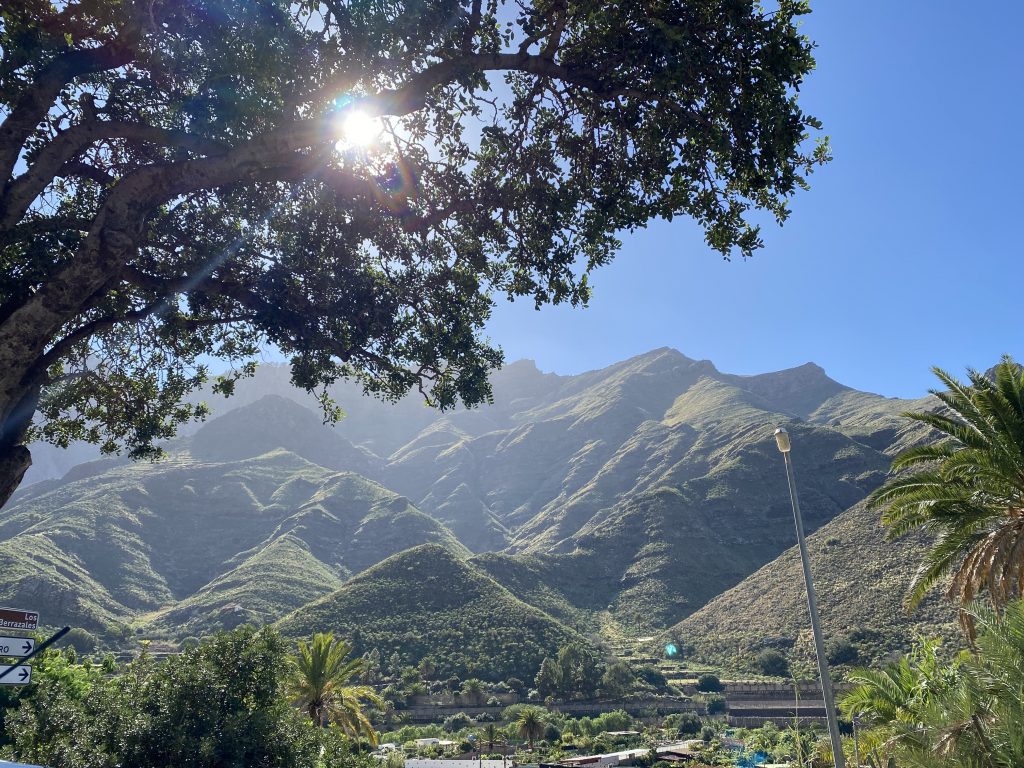
If you have chosen the northwest of Gran Canaria for your holiday, you are probably not looking for miles of golden sandy beaches. Those beaches are to be found in the south of the island. Those who venture to the north are looking for – and finding – a natural environment, an unspoilt, rural culture, good food and stunning scenery.
Even if you prefer a holiday in the mountains, a stay in Gran Canaria without a good dip (or two) on the beach would not be a stay in Gran Canaria. Here are a few places where you can take that dip that will taste like holy glory.
The beaches in the north and northwest of Gran Canaria are rocky and have black sand due to their volcanic origin. This region experienced intense volcanic activity in the past, which resulted in the formation of dark rocks and minerals that broke down over time to form the black sand we see today. In contrast, the beaches in the east and south of the island tend to have lighter sand because they are composed mainly of crushed coral and shell debris, as well as lighter minerals that have eroded from the surrounding rocks. This difference in sand composition is due to the unique geology of each region of the island. A walk along some of the beaches in the northwest will lead you to discover their geological peculiarities.
The beaches of Agaete
Playa de las Nieves
The beach of Puerto de las Nieves is divided in two by the old pier. To its left, where the legendary Dedo de Dios (a rock formation reminiscent of a hand with its index finger raised) used to be, there is a sandy area where you can sunbathe comfortably and children can play on the shore. On the other side, in front of the new pier, the ground is covered with large stones that make access difficult and sunbathing uncomfortable. A large wooden platform, which serves as a solarium, allows you to sunbathe without getting your back stuck in the stones.
The old dock
El Dedo de Dios was broken by a violent storm in 2005 and all that remains is the fist. The old pier also became history with the construction of the new quay where the ferry to Tenerife docks. However, this little dock is nowadays a perfect place to bathe in the sea on hot days. There are stairs down which were used to load and unload the fishing boats, and the town has installed pool ladders for those who don’t want to jump in when the tide is low.
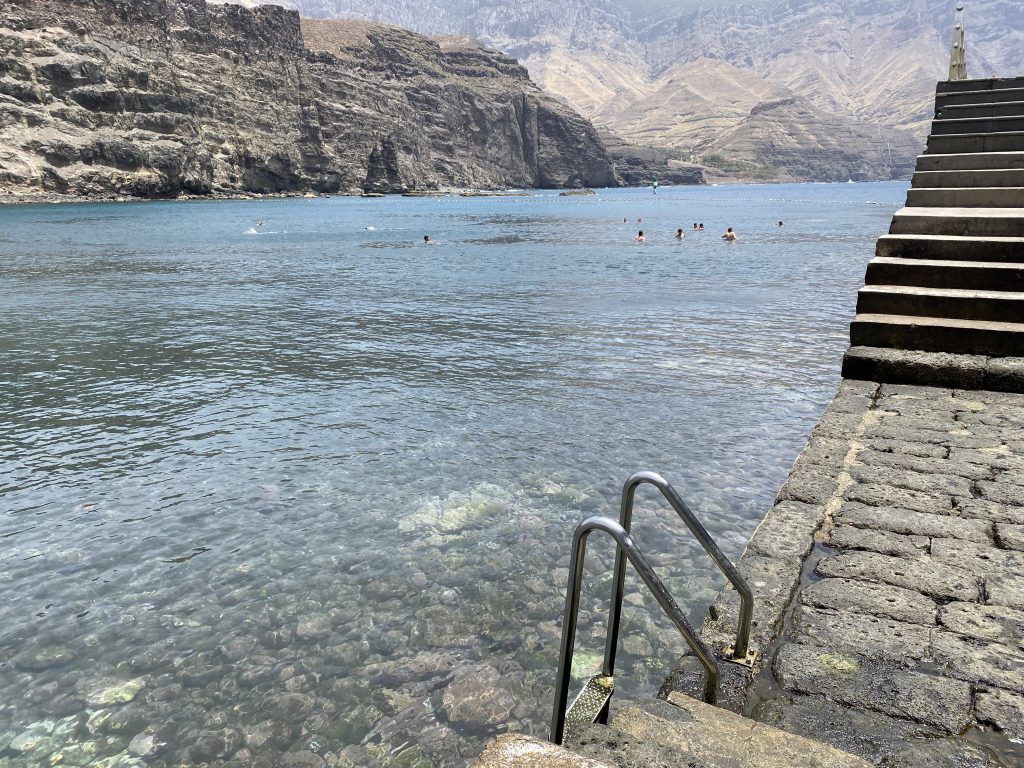
The locals leave their clothes on a bench running the length of the quay and jump down the ladders into the sea. Children and young people even dare to jump from the top of the old loading crane when the tide is high and the depth is sufficient.
The natural pools of Agaete (Las Salinas)
A spectacular place to soak in the ocean, sheltered from the waves, are the natural pools of Agaete. Composed of three volcanic lava pools of different depths and connected by underground tunnels, the natural pools allow you to swim without waves in crystal-clear water that is renewed every time the tide comes in. The facilities include a solarium, toilets, car park and even a simple restaurant where you can recharge your batteries after swimming.
Located at the mouth of the Barranco de Agaete ravine, from the 17th century until well into the 20th century, enough salt was harvested here to supply a large part of the north of the island. Hence its name, Las Salinas.
If you decide to spend the day in the natural pools, it is advisable to bring a deckchair or mat, as the solarium is made of stone. For bathing, it is advisable to wear booties or some kind of aquatic footwear for walking on the rocks. Don’t forget swimming goggles or even snorkelling goggles.
The pools can be easily reached on foot from Puerto de las Nieves or from the neighbourhood of El Turmán.
Playa de Guayedra
Guayedra beach can be reached on foot from Agaete in a couple of hours. It is a nice walk that ends with the undoubted reward of a swim at this beach. It is the mouth of one of the most beautiful ravines of Gran Canaria. If you wish to continue your walk, venture inland to discover an oasis of palm trees and native vegetation.
Guayedra beach, like most of this area, requires caution when bathing due to the risk of currents. Take precautions and, in the event of strong waves, leave bathing for another day or for a more sheltered spot.
Playa del Risco de Agaete
Leaving Puerto de las Nieves towards the south in the direction of La Aldea, you will find El Risco beach, which is easily accessible by car. It is located at the height of the mud of the same name, so called because it is perched on the mountain. It is a dark sandy beach, very quiet despite being accessible by car. It is perfect for swimming in summer when the tide is low. However, this very open beach requires a lot of caution when there is a swell. Don’t take unnecessary risks. It is not worth it.
Beaches of La Caleta and El Juncal
Continuing from the natural pools northwards along the coastline, past the El Turmán neighbourhood, is the small pebble beach of La Caleta with moderate waves. It can be reached on foot along a path from El Turman. Further north is El Juncal, also pebbly, which can only be reached on foot or from the sea.
Beach of Sardina del Norte (Galdar)
Further north is Sardina, 12 kilometres from Agaete, in the municipality of Gáldar. This is a small village beach, frequented mainly by locals. It has dark sand, like the other beaches in the north, and is fairly quiet, especially on weekdays. The water is usually crystal clear and it is the perfect place to watch the sunset in the shelter of the bay.