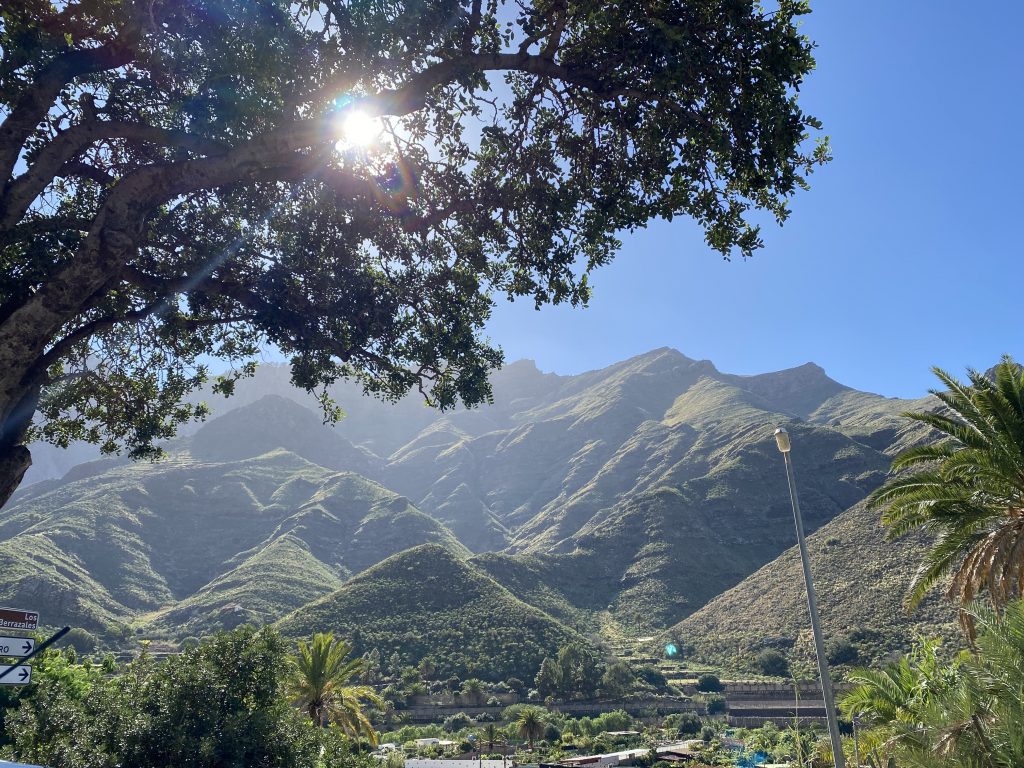
Where to shop in Agaete and surroundings

Discovering local delicacies is one of the things I enjoy most about travelling. And I don’t just like discovering them in restaurants, I also love checking out the food on offer in local shops. 

If you are staying at Casa Mimosa in the Agaete Valley, a quick glance at Google Maps will show you that there is nowhere nearby to buy bread for breakfast. That is one of the charms of this place: maximum tranquillity. So much tranquillity that there are no shops. 

That’s why it’s important to plan your trip to the supermarket in advance. Ideally, you should do your first shop as soon as you land, as soon as you leave the airport in your hire car. On the way from the airport to Casa Mimosa, you will pass at least five well-stocked supermarkets. I always recommend stopping in San Isidro (Gáldar), 8 kilometres before you reach Casa Mimosa. This way, your food won’t have to spend too much time in the boot of your car if it’s hot. 

Where to shop in Gáldar

Leaving Gáldar towards Agaete, you will find the exit to San Isidro on the right-hand side of the road. If you take this exit, you will immediately see three large supermarkets at the top: Hiperdino, Mercadona and Lidl.

  • Hiperdino is my favourite because it is a 100% Canarian-owned company. According to its website, 45% of its regular stock is of Canarian origin and more than 60% of its fruit and vegetables are locally sourced. In general, it has a wide variety and good prices. The San Isidro branch is quite large and is ideal for late shopping as it is open until 10 pm. 
  • Mercadona is a chain from Valencia. It is also competitive in terms of prices, but it achieves this partly by reducing its range. It has less variety and many own-brand products. This does not mean that the quality is lower: Mercadona’s own-brand, Hacendado, has a very good reputation. However, if you are looking for a particular wine or a very specific product, you may not find it.
  • Lidl is a German chain. If you come from Germany and can’t do without your leberwurst and sauerkraut, this is your supermarket in Gran Canaria. Both Lidl and other German chains (Aldi, for example) adapt their product range in their Canary Islands stores and, obviously, they don’t only stock German products. However, I like my money to contribute to local development and strengthen the economy of the place I am visiting. That’s why I tend to spend my money in Canarian businesses when I’m in the Canary Islands. When I’m in Berlin, where I live, Lidl is my favourite supermarket because they have the best fruit and vegetables at very good prices.

Where to shop near the airport if you land late

If you don’t have time to get to Gáldar to do your shopping before 10 p.m., I recommend you do it when you leave the airport at Alcampo or Carrefour.

  • Alcampo is in the La Mareta Shopping Centre, about 9 kilometres along the motorway towards Las Palmas. If there is no traffic, you can be queuing at the deli counter in 15 minutes. You will see it from the motorway because it is next to IKEA. Take exit number 7 to ‘Parque Comercial / La Estrella’.
  • Carrefour: If you don’t like Alcampo and still have some time, the other option is Carrefour in Hoya la Plata, as you enter Las Palmas. Although it is already in the capital, this Carrefour is very easy to access from the motorway and you can’t miss it. Take exit 0 to ‘Hoya la Plata / Pedro Hidalgo‘. Both Carrefour and Alcampo are hypermarkets and therefore sell not only food but all kinds of things. If you’ve forgotten your beach sandals, swimsuit or hat, you’ll find what you need here.

Where to shop in Agaete

If you are staying at Casa Mimosa or any other accommodation in the Agaete Valley, you will be pleased to know that there is also a supermarket in Agaete which, although with less variety and less competitive prices, can help you out on a day when you don’t feel like driving to Gáldar. This is the SPAR in La Palmita, a Dutch and Canarian franchise that can be found all over the island. You will find it halfway between Agaete and Puerto de las Nieves.

If you feel like taking a walk to San Pedro (just over a kilometre away), you will find Bar La Palma, where you can not only have a beer on the terrace while admiring the mountains, but also enjoy the best avocado salad in the valley. And it is no coincidence that it is the best, because they make it with avocados from the valley. Right here, in the bar, you can buy them in season. Not only avocados, but also oranges, mangoes, tomatoes and any other fruit and vegetables grown in the surrounding area, as well as coffee and anything else you might need for your pantry.

Where to buy agricultural and artisan products in the north of Gran Canaria

If you are a cheese lover like me, you will love the Mercado de Guía (Guía Market). Some of the best cheeses on the islands are made in the north of Gran Canaria, especially in the areas around Guía and Gáldar. The most famous of these is queso de flor, followed in popularity by queso de media flor. Don’t expect to find flowers in the cheese. The name has to do with the production process, which uses vegetable rennet from thistle flowers. Depending on whether you buy it in summer or winter, the cheese has a different consistency and degree of acidity. The cheese sold in winter is made in summer, and vice versa. My favourite is the one made in summer and sold in winter. It’s the creamiest. A delight. If you find the one made in Los Caideros (Gáldar), don’t hesitate to at least try it. It’s one of the best.

Obviously, they don’t just sell cheese at the Guía Market, but also artisan bread made from potatoes or corn and all kinds of local delicacies. A stroll through the market is well worth it. It’s a pity that it’s only open from Friday to Sunday until 3 pm.


Would you prefer to find your shopping done when you arrive at Casa Mimosa? For your convenience, we can leave some basic products ready for dinner and breakfast. Just let us know and we’ll be happy to organise it.
The best beaches in the northwest of Gran Canaria

If you have chosen the northwest of Gran Canaria for your holiday, you are probably not looking for miles of golden sandy beaches. Those beaches are to be found in the south of the island. Those who venture to the north are looking for – and finding – a natural environment, an unspoilt, rural culture, good food and stunning scenery. 

Even if you prefer a holiday in the mountains, a stay in Gran Canaria without a good dip (or two) on the beach would not be a stay in Gran Canaria. Here are a few places where you can take that dip that will taste like holy glory.

The beaches in the north and northwest of Gran Canaria are rocky and have black sand due to their volcanic origin. This region experienced intense volcanic activity in the past, which resulted in the formation of dark rocks and minerals that broke down over time to form the black sand we see today. In contrast, the beaches in the east and south of the island tend to have lighter sand because they are composed mainly of crushed coral and shell debris, as well as lighter minerals that have eroded from the surrounding rocks. This difference in sand composition is due to the unique geology of each region of the island. A walk along some of the beaches in the northwest will lead you to discover their geological peculiarities.

The beaches of Agaete

Playa de las Nieves

The beach of Puerto de las Nieves is divided in two by the old pier. To its left, where the legendary Dedo de Dios (a rock formation reminiscent of a hand with its index finger raised) used to be, there is a sandy area where you can sunbathe comfortably and children can play on the shore. On the other side, in front of the new pier, the ground is covered with large stones that make access difficult and sunbathing uncomfortable. A large wooden platform, which serves as a solarium, allows you to sunbathe without getting your back stuck in the stones.

The old dock

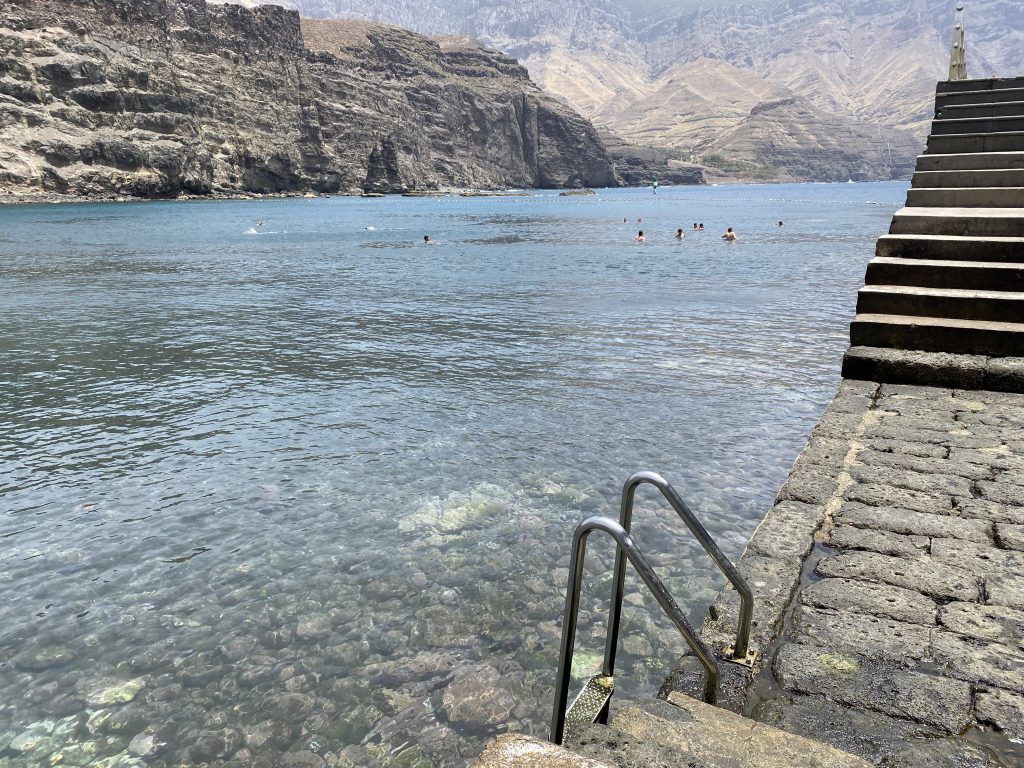
El Dedo de Dios was broken by a violent storm in 2005 and all that remains is the fist. The old pier also became history with the construction of the new quay where the ferry to Tenerife docks. However, this little dock is nowadays a perfect place to bathe in the sea on hot days. There are stairs down which were used to load and unload the fishing boats, and the town has installed pool ladders for those who don’t want to jump in when the tide is low.

The old dock of Agaete

The locals leave their clothes on a bench running the length of the quay and jump down the ladders into the sea. Children and young people even dare to jump from the top of the old loading crane when the tide is high and the depth is sufficient. 

The natural pools of Agaete (Las Salinas)

A spectacular place to soak in the ocean, sheltered from the waves, are the natural pools of Agaete. Composed of three volcanic lava pools of different depths and connected by underground tunnels, the natural pools allow you to swim without waves in crystal-clear water that is renewed every time the tide comes in. The facilities include a solarium, toilets, car park and even a simple restaurant where you can recharge your batteries after swimming. 

Located at the mouth of the Barranco de Agaete ravine, from the 17th century until well into the 20th century, enough salt was harvested here to supply a large part of the north of the island. Hence its name, Las Salinas. 

If you decide to spend the day in the natural pools, it is advisable to bring a deckchair or mat, as the solarium is made of stone. For bathing, it is advisable to wear booties or some kind of aquatic footwear for walking on the rocks. Don’t forget swimming goggles or even snorkelling goggles. 

The pools can be easily reached on foot from Puerto de las Nieves or from the neighbourhood of El Turmán.

Playa de Guayedra

Guayedra beach can be reached on foot from Agaete in a couple of hours. It is a nice walk that ends with the undoubted reward of a swim at this beach. It is the mouth of one of the most beautiful ravines of Gran Canaria. If you wish to continue your walk, venture inland to discover an oasis of palm trees and native vegetation. 

Guayedra beach, like most of this area, requires caution when bathing due to the risk of currents. Take precautions and, in the event of strong waves, leave bathing for another day or for a more sheltered spot.

Playa del Risco de Agaete

Leaving Puerto de las Nieves towards the south in the direction of La Aldea, you will find El Risco beach, which is easily accessible by car. It is located at the height of the mud of the same name, so called because it is perched on the mountain. It is a dark sandy beach, very quiet despite being accessible by car. It is perfect for swimming in summer when the tide is low. However, this very open beach requires a lot of caution when there is a swell. Don’t take unnecessary risks. It is not worth it.

Beaches of La Caleta and El Juncal

Continuing from the natural pools northwards along the coastline, past the El Turmán neighbourhood, is the small pebble beach of La Caleta with moderate waves. It can be reached on foot along a path from El Turman. Further north is El Juncal, also pebbly, which can only be reached on foot or from the sea.

Beach of Sardina del Norte (Galdar)

Further north is Sardina, 12 kilometres from Agaete, in the municipality of Gáldar. This is a small village beach, frequented mainly by locals. It has dark sand, like the other beaches in the north, and is fairly quiet, especially on weekdays. The water is usually crystal clear and it is the perfect place to watch the sunset in the shelter of the bay.

Where to eat in the Agaete Valley (and surroundings)

If you are staying at Casa Mimosa or any other holiday accommodation in the Agaete Valley, you will have noticed that the Valley is not distinguished by a lively social life. And that’s just as well: those who come here are looking for disconnection, nature and relaxation, walking the paths up the valley to the sound of blackbirds and listening to the shearwaters on summer evenings.

However, it would be a shame to leave a place like this without having tasted the delights of the local gastronomy. We invite you to discover the Canarian cuisine through a gastronomic immersion in the Agaete Valley (and surroundings) that will give you a few surprises.

Casa Lolo

Starting from the closest: leaving the Urbanización la Suerte, you will find on the right hand side the restaurant Casa Lolo, which has been serving grilled meat and fish next to the road for decades. It is a very simple but historic place where you can enjoy dishes without great artifice but with substance. The speciality is the grill and local cuisine in general. Good food at reasonable prices. As I’m more into greenery than meat, what I like most about Casa Lolo is the spectacular salad, where avocado and papaya go hand in hand with lettuce, tomatoes and the best of the local terroir.

Bar La Palma

The village of San Pedro is a stone’s throw from La Suerte, the perfect distance for a stroll on foot (be careful on the road: the verges are narrow). In the heart of San Pedro, after walking through Las Cuevecillas along the fork off the main road to the right, you will find the bar La Palma. The owner of the bar is said to make the best avocado salad in the Valley, and I believe it. Croquettes, papas arrugadas (wrinkled potatoes) and fabada (bean stew) are also regulars on the blackboard (there is no menu). All very homemade and unpretentious, at reasonable prices.

You can take advantage of the refreshment stop to buy local fruit and vegetables (be sure to try the oranges and papayas) and other food items sold in the bar itself.

Casa Romántica

Here we go to another level. The Casa Romántica restaurant, which you’ll find on the road up towards Los Berrazales, just over a kilometre from La Suerte, has been recommended by the Michelin Guide. It is an obligatory stop for gourmets and for all those who appreciate high quality cuisine based on local produce. The tasting menu, priced at 70 euros, is the modern interpretation of a journey through traditional Canarian gastronomy. Unlike most restaurants in the Canaries, Casa Romántica includes vegan dishes on its menu. The prices are not exorbitant and the sensory experience is worth it. But don’t forget to book in advance.

Refugio El Hornillo

This one is for the brave. The best way to get here is to walk up the valley, either from San Pedro or from El Sao, the highest point of the mountain which can be reached by car. It is also possible to get there by car by making a long detour via San José de Caideros and Fagajesto, but it takes almost an hour and the last stretch of road is not for the faint of spirit. 

If you dare to walk up, the top of El Hornillo will not only give you unparalleled views of the valley and the ocean, but also the opportunity to recharge your batteries in an exceptional place. El Refugio is a small guesthouse in the old school of the village of El Hornillo where the host, Nicola, an affable Italian and a great cook, produces the best of Canarian gastronomy on his cookers. Apart from the culinary aspect, the interest of El Hornillo also lies in the fact that it is a village of cave houses, a type of dwelling that is very common towards the centre of the island.

Where to eat in Agaete and Puerto de las Nieves

The town of Agaete and Puerto de las Nieves are full of good restaurants. We are going to highlight three, each for different reasons.

El Perola, an institution*

In the middle of the village square, opposite the church, the bar El Perola is an institution and a stop on its terrace, even for a beer and a tapa, is irresistible. At very reasonable prices, its menu starts with the traditional ropa vieja, a pork and chickpea stew with thyme aroma that sums up the essence of Canarian cuisine. El Perola also surprises with an unusual dish: cockles with chips, perfect to nibble on with a cold beer on the terrace. And on Sundays there is sancocho, a typical Canarian dish par excellence that you can’t find in many restaurants. 

*Update: Unfortunately, in November 2025, El Perola closed its doors to the public after 33 years of existence.

Angor, the best fish

If you want to eat the best fresh fish on the island, don’t miss a stop at Puerto de las Nieves. Of all the fish restaurants here, the one most recommended by the locals is the Angor terrace. While you’re here, be sure to take a dip in the sea, either at the pier, on the beach or in the natural pools. After your swim, let yourself be pampered by this family-run restaurant, which will bring the best of the sea to your table. It is usually very crowded at lunchtime for the locals (from 2 to 4 pm). If you arrive earlier, you’re sure to find a table. This place has only one flaw: on very hot days the terrace can be a bit uncomfortable. Consider going to another air-conditioned restaurant if the high temperatures are going to ruin the experience.

Hondo Café, something different

This is a relatively new establishment, located at the local swimming pool in the La Palmita neighbourhood. It is small and subject to the opening hours of the pool, so it is not open at night. But you won’t regret coming to try it.

Run by an Italian and a Japanese woman, Hondo Café has nothing to do with regional Canarian cuisine and is a breath of fresh air if you’ve been eating fish and papas arrugadas for a week. Hondo has a small and changing menu, with influences from many parts of the world, and always with vegetarian and vegan options. This is not the place where you would expect to find such a restaurant, and the surprise is certainly a pleasant one. The chef, Michele, is adorable and the presentation of the dishes is wow. Highly recommended.

What to eat in the Agaete Valley

In the Agaete Valley, food is much more than a necessity; it is an expression of Canarian culture and tradition. In this corner of Gran Canaria, the diversity of local ingredients and the freshness of the sea merge to create a unique gastronomic experience. From the tropical fruits that flourish in its fertile soil to the fresh fish that arrives in the port of Las Nieves, each dish tells a story of life in the Canary Islands.

Fruits and coffee farms in the Agaete Valley, Gran Canaria

Tropical fruits of the Agaete Valley

A wide variety of tropical fruits thrive in the Valley thanks to the subtropical climate and excellent soil conditions. Mangoes, papayas, avocados, citrus fruits and guava enrich the diet of the locals and delight visitors. As it is not a large production area, it is not easy to find the products of the valley outside Agaete. However, visitors who visit the farms and buy directly from the farmers are rewarded with products of excellent quality and taste.

A good alternative to buying directly from the farm is to visit the Bar La Palma in the village of San Pedro. As well as offering daily coffees, drinks and meals, Bar La Palma sells local fruit and vegetables. There you will find a selection of the best seasonal fruit of the valley and beyond.

Agaete coffee: A local treasure

The Agaete Valley is the only place in Europe where coffee is grown on a commercial basis. Agaete coffee, grown among the Tamadaba mountains, reflects the dedication and love of the local farmers for their land. Some producers, such as Finca Los Castaños and Finca La Laja, offer guided tours of their plantations. Visiting the farm offers a unique opportunity to learn about each stage of the coffee growing and production process.

The farms also offer the opportunity to taste and buy coffee, allowing visitors to take home a piece of this unique experience. Each cup of coffee tells a story of the land and the hands that cultivate it, celebrating the authenticity and tradition of the Agaete Valley.

Agaete Valley wines: A centuries-old winemaking tradition

In the Agaete Valley a grape variety called listán negro is cultivated, which was brought from Castile in the 16th century and then taken to the Americas, where it is still grown today. In the Canary Islands, listán negro is grown mainly in several wine regions in Tenerife and to a lesser extent on other islands.

The most notable bodega in the Valley is the Bodega Los Berrazales, which offers guided tours with wine tasting. It produces a modest but notable selection of red, white and rosé wines that reflect the hard work of the local winegrowers and the unique climatic and soil conditions that characterise the Valley.

Fish: The taste of the sea

Where the ravine of Agaete meets the Atlantic Ocean, an old fishing village, the port of Las Nieves, offers one of the most emblematic gastronomic delights of the north of Gran Canaria: fresh fish.

Vieja, sama, wreckfish and grouper are just some of the marine treasures that the local fishermen bring ashore. Prepared with simplicity and respect, these fish are served in traditional dishes such as “Vieja a la espalda” or “Cherne en salsa verde”, where the freshness of the sea shines with every bite.

Several beachside restaurants vie daily for the honour of offering the best fish in the area. A tip: accompany your fish dish with an abundant salad and a bowl of blanched gofio (“gofio escaldado”).

A glimpse of the essence of the Agaete Valley

From the tropical fruits that caress our senses to the coffee that awakens our mornings, each mouthful tells a story of the land and the hands that work it with care. In the vineyards and the sea, on the farms and in the kitchens, we find the deep connection between the people and the land they call home. It is a relationship rooted in tradition and respect, a celebration of life and the abundance of a land that has always been one of the most fertile and grateful on the island of Gran Canaria.

As we savour the dishes of the Agaete Valley, we not only experience its culinary richness, but we also immerse ourselves in its culture and history. Each ingredient, each recipe, speaks of the passion and pride of those who call this valley their home.

Is tap water in Gran Canaria safe?

This is a subject that is not discussed in the Canary Islands because it is one of those “truths” accepted by everyone that, if you do a little research, turns out not to be true: “Tap water from Gran Canaria should not be drunk”. Actually, locals don’t claim that it is harmful, but everyone recommends drinking bottled water “just in case”.

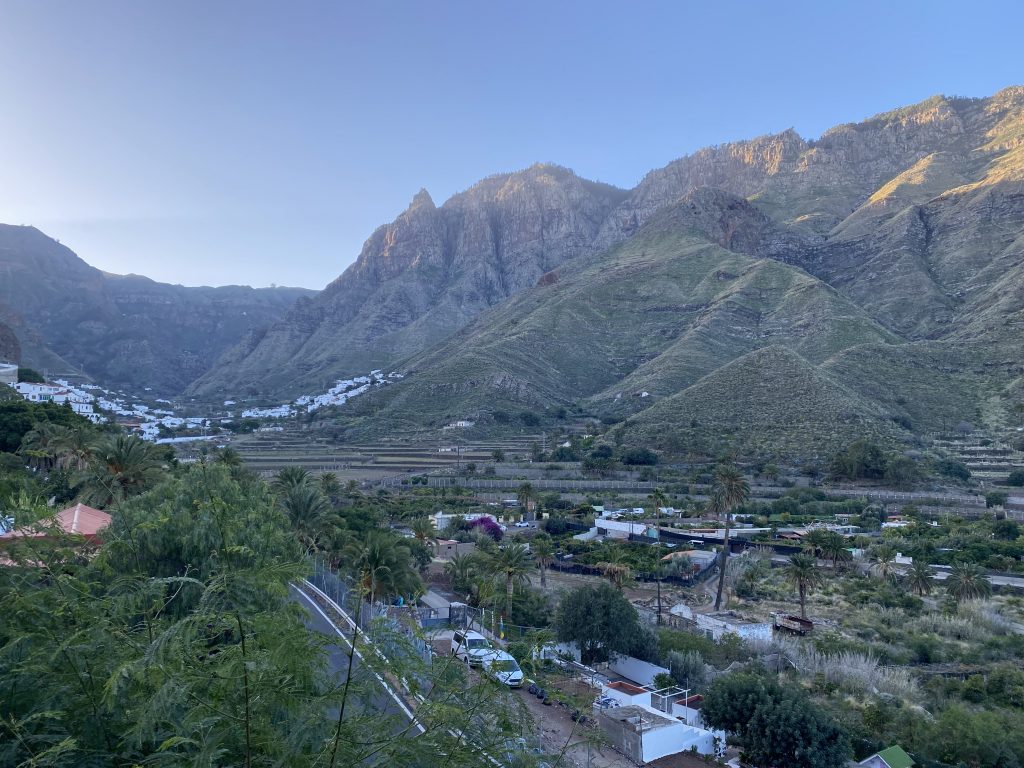
Tamadaba mountains viewed from the Agaete Valley

The carbon (and water and energy) footprint of bottled water

Do you know how much CO2 is released into the atmosphere by the manufacture of bottles, bottling and transportation of water for human consumption? Many scientific studies have tried to calculate the carbon footprint of bottled water. For every 1.5 litre bottle, between 44 and 600 grams of CO2 are released into the atmosphere, depending on which scientific study is consulted. Added to this is the consumption of energy (between 5.2 and 10.2 MJ per one-litre bottle) and water (17.41 litres per one-litre bottle). Because to bottle a litre of water, not only the litre inside the bottle is consumed. The bottle manufacturing plant consumes water for production, plus bottling and transport to your hands.

For these reasons, we at Casa Mimosa encourage you to avoid buying bottled water whenever possible.

Can you drink tap water in Gran Canaria or do you have to buy bottles?

Fortunately, tap water is safe to drink in Gran Canaria. You will notice that the local people never drink tap water and if you ask them, they will always recommend you to buy bottled water. Sadly, this was necessary years ago. When I grew up in Las Palmas in the 70s and 80s, the water that came out of the tap came from a water treatment plant that extracted and desalinated water from the sea. It was not advisable to drink it and you didn’t want to because the taste was awful.

Some things have changed since then. Nowadays, tap water in all of Spain is drinkable, including that of Gran Canaria. The quality of the water in the city of Las Palmas, although it still comes from the desalination plant, is among the best in Spain according to a recent study by the Spanish Consumers and Users Organisation (OCU). Although the quality of the water is excellent, the same cannot be said of its taste. In Las Palmas the “agua del chorro”, as we say here, still has a chlorine aftertaste that is not pleasant to the palate. But as soon as one leaves the capital for the midlands, the taste improves.

The University of Las Palmas did a study of the island’s water in 2021 and found that it is perfectly safe and meets all the necessary indicators. The author of the study also pointed out that tap water complies with much stricter health regulations than bottled water and that it is the most closely monitored of all the foodstuffs we consume.

Why do locals still drink bottled water?

The quality of water has improved a lot since I grew up in Gran Canaria, but there seems to have been no political will to change its bad image among the public. This is not surprising when you consider the economic power of the companies that have an interest in continuing to sell bottled water, starting with Coca-Cola and continuing with Nestlé. In many cases, the water bottled and sold by these companies is tap water.

This, combined with the fact that the taste of water in Las Palmas can still be improved, has contributed to the perpetuation of the legend of unhealthy water. The population is not sure if the water is safe to drink, but instead of informing themselves, most people prefer to continue drinking bottled water “just in case”.

Is it safe to drink tap water in the Agaete Valley?

In the Agaete Valley we have the privilege that the water is not only drinkable and perfectly safe, but also tastes surprisingly good. In fact, in the upper part of the valley you can still see the remains of the old “Aguas de Agaete” bottling plant. The water of Agaete was one of the most prized on the island, along with that of Firgas, San Roque, Teror and Los Tilos de Moya, which was the water we drank at home. There was a bottling plant in almost every village. In Arucas they were smarter and started distilling rum (if you like rum, don’t forget to try it, it’s called Arehucas).

If you are staying in Gran Canaria we encourage you to fill your water bottle with tap water and avoid carrying bottles or carafes unnecessarily.